Design language
The frontend is the product, so the identity is deliberate and plain: a typewriter atlas.
The thesis
Solaria is a typewriter atlas: a pure black canvas, one typeface, a single orange accent, and a dotted world map. Calm and spacious, technical, no gradients to hide behind. The restraint is the point, since the work and its proof are the loud part.
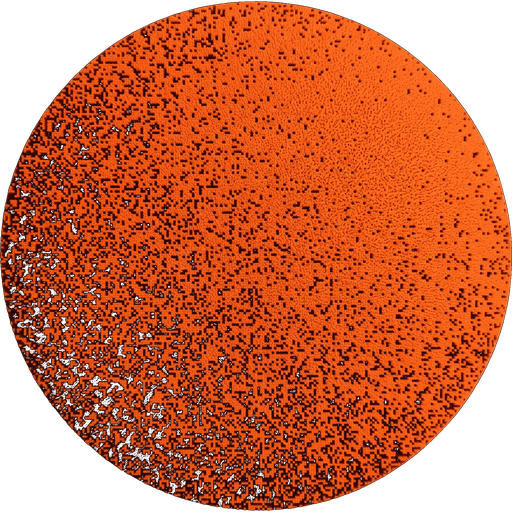
One accent does all the work. Orange (#ff5d1a) marks anything live or active; warm white is the text; everything else is black and hairline borders. The swarm renders as 3D orbs, the mark is an orange dithered orb, and the proof line is the one place the machine speaks.
Color
The palette, as shipped in the design system.
- bg#000000background, pure black canvas
- orange#ff5d1athe single accent, anything live or active
- orange-bright#ff8a3daccent highlight, hover
- ember#c2410cdeepest accent, low-effort work
- ink#f4f3f1text, warm white
- ink-dim#9b9a97secondary text
- ink-faint#66645flabels and chrome
Type
One voice, everywhere. Solaria is set entirely in Courier Prime, a clean typewriter. The weight carries the hierarchy, not a second family: bold for headings and labels, regular for body and data. The same face renders the human claim and the verifiable hash, which is the point.
- Headings. Courier Prime, bold. Titles, section heads, and labels.
- Body. Courier Prime, regular. Prose, the default voice.
- Data and chrome. The same Courier Prime for hashes, merkle roots, transcripts, addresses, and stats. The machine and the writer share a typewriter.
Layout
A dotted world atlas anchors the page, with the orb mark and wordmark top-left and live telemetry along the bottom. Cards are soft, rounded, and hairline-bordered, and the layout stays spacious. Boldness is spent on the orb and the orange accent; everything else stays quiet and disciplined.